Archive

Tag Archives: healthcare

Evidence of New / Escalating Criticism of Lincolnshire Adult Social Care

Ombudsman / Care Act Failures

A recent (April 2025) LGO decision (ref 24-003-962) found fault in how LCC (via Lincolnshire Partnership NHS Trust, acting for LCC) handled a Care Act assessment and care plan for a person with mental and physical health needs. Specifically: no advocate was involved despite communication difficulties, care was inconsistent, and there was poor communication / information-sharing — this caused distress. Local Government Ombudsman

Another case (Centre for Adults’ Social Care report, June 2025) describes a woman with complex mental health needs whose move into the county triggered fragmented / inadequate support. LCC (via its partner trust) failed to provide consistent care, arranging too few hours vs her assessed need, and she suffered distress, hospital admissions, and isolation. cascaidr.org.uk

A separate Ombudsman ruling (July 2025) relates to transition from children’s to adult services. LCC made “errors in care package decisions and communications” for a young adult with disabilities (including transport for day-centre attendance), causing her to miss care. cascaidr.org.uk+1

Healthwatch Lincolnshire Feedback

The Healthwatch Lincolnshire report (2025) includes a case (Feb 2025) of an adult social care user whose health needs were compromised because of lack of proper care provision. According to the report, the person is a wheelchair user and needs increased care post-operation, but LCC could not guarantee provision for that increased care, leading to the cancellation of a surgery. Healthwatch Data

While this is not explicitly “mental health care,” it shows stress / risk in how adult social care assesses and responds to changing care-need demands — including when health interventions (surgery) would make care needs temporarily more intense.

Local Media / Policy

Lincolnshire World reported very recently (Oct 2025) that LCC officials are considering reducing the number of “active recovery beds” (mental-health-related step-down beds) from 29 to 24. That’s a significant signal: reducing capacity in part of the mental health recovery system could be seen as cutting back or deprioritising mental health care for adults. LincolnshireWorld

Complaint Statistics

In its 2024–2025 complaints report, LCC notes that 23 complaints from that year were escalated to the LGSCO about adult care. Lincolnshire County Council

While not all these will be about mental health, it suggests a non-trivial volume of serious complaints in the adult care sphere.

Interpretation & Assessment

The Ombudsman findings are the strongest concrete evidence: there are real cases where LCC has failed to provide or plan care properly for people with mental health or complex needs. These are not isolated paperwork mistakes, they have caused distress and had a material negative impact.

The Healthwatch case indicates that some people struggle to get social care to respond when their health needs (which may interact with mental health) change. That could suggest capacity / resource problems in LCC’s adult social care provision.

The proposal to reduce active recovery beds is worrying: if implemented, it could worsen recovery pathways for people needing step-down mental health care. That could be a policy direction that reduces service rather than expands it.

However, the CQC’s most recent (pilot) assessment of LCC adult social care is still “Good”, which means from a regulator’s perspective, the overall adult social care system is functioning reasonably well (though not without room for improvement, especially in certain pathways). Lincolnshire County Council+2Care Quality Commission+2

There is new and escalating criticism of LCC’s mental-health-related adult care: through Ombudsman decisions, Healthwatch reports, and potentially in policy (bed reductions).

The criticisms are not wholesale systemic collapse, but they do raise serious concerns about how well LCC is meeting the needs of vulnerable adults — particularly those with complex mental health or changing care needs.

Some of the key pressure points: assessment and care planning, continuity / consistency of care, capacity in recovery services, and responsiveness to changing needs.

Briefing Summary: Criticisms of LCC Adult Mental Health Care (2023–2025)

1. Financial & Demand Pressures

LCC’s 2024/25 financial performance review reports a significant overspend in mental health adult care:

Community supported living (for working-age / mental health clients) overspent by £3.2 million, of which £1,060,000 relates to “Growth in demand for DoLS / LPS” (Liberty Protection Safeguards) due to a much higher-than-expected increase in client numbers (94 new clients vs 25) planned). lincolnshire.moderngov.co.uk+2lincolnshire.moderngov.co.uk+2

Long-term residential mental health care also saw growth: 27 new clients, resulting in a £0.408 million overspend. lincolnshire.moderngov.co.uk+1

Short-term care (mental health) clients exceeded budgeted numbers, adding further financial pressure. lincolnshire.moderngov.co.uk+1

The budget for 2025/26 continues to forecast rising demand in mental health: LCC recognizes a 3–6% annual growth in working-age / mental health service demand. lincolnshire.moderngov.co.uk

In its executive meeting (Aug 2025), the Overview & Scrutiny Management Board flagged this as a “volatile and risk-based” budget area, with ongoing close monitoring. lincolnshire.moderngov.co.uk

Implication: LCC may be under-estimating both the scale and pace of demand growth for mental health care, risking repeated overspends and service strain.

2. Service Reduction Controversies – Active Recovery Beds

Local media (LincolnshireWorld) report that LCC is proposing to reduce the number of Active Recovery Beds (ARBs) from 29 to 24. LincolnshireWorld

These beds are used for people stepping down from hospital but not yet ready to return home, reducing them could limit “step-down” capacity. LincsOnline+1

The Council argues the reduction aligns with “presenting demand” and will improve occupancy (from ~70% to ~90%). LincolnshireWorld

However, some councillors have expressed concern: e.g., whether this reduction under-provides in the face of broader NHS / social care pressures. LincolnshireWorld+1

Implication: The proposed cut could undermine recovery capacity; critics worry demand may outstrip reduced supply, especially as patients leave hospital.

Ombudsman Findings – Assessment & Care Planning Failures

In LGO decision 24-003-962 (April 2025), the Ombudsman upheld a complaint against LCC:

LCC (via its partner, Lincolnshire Partnership NHS Trust) failed to provide reasonable adjustments in a Care Act assessment despite the complainant’s mental and physical health issues. Local Government Ombudsman

The decision-making was inconsistent: carers were not familiar with her, there was inadequate handover, and no advocate was involved even when needed. Local Government Ombudsman

The Council also made housing decisions (moving the person) that the Ombudsman found unsuitable. Local Government Ombudsman As a remedy: LCC must apologise and pay a sum to acknowledge the injustice caused. Local Government Ombudsman

A separate Cascaidr analysis (July 2025) highlights another case: LCC failed to properly manage a care package for a person with mental health and possibly autistic traits. Adult Social Care Centre

The complaint noted that LCC did not properly assess the person’s capacity or share information with providers, leaving her without adequate support. Adult Social Care Centre

The analysis argues that LCC’s assessment systems / legal understanding may be weak in dealing with complex, capacity-fluctuating mental health cases. Adult Social Care Centre

Another Cascaidr / Ombudsman case (Sept 2025): poor management of transition from children’s to adult services for a young woman with disabilities (including mental health / supportive needs). Adult Social Care Centre

The Council initially promised transport + day-centre attendance but later withdrew transport without confirming that a closer centre could meet her needs, resulting in missed care. Adult Social Care Centre

The Ombudsman found LCC at fault: decisions were made without fully checking alternatives; communication was confusing; and there was procedural failure in its authorisation processes. Adult Social Care Centre

The Council was required to apologise and pay a symbolic amount, and to remind staff about proper internal authorisation procedures. Adult Social Care Centre

Implication: There appear to be systemic weaknesses in LCC’s assessment, planning, and communication processes especially for people with complex mental health needs or transitioning from children’s services. This raises risk of unmet need, distress, and legal non-compliance.

Local Advocacy / Healthwatch Voice

Healthwatch Lincolnshire’s 2024/25 Annual Report shows increasing engagement, but also highlights challenges: while not all issues are mental health–specific, many concern social care access, capacity, and unmet needs. healthwatchlincolnshire.co.uk

In the 2024–25 interim work plan, Healthwatch identified “influencing decision-makers” and “addressing underrepresented groups” as key priorities, suggesting they are pushing for more responsive, inclusive care provision. healthwatchlincolnshire.co.uk

Local media commentary (LincolnshireWorld) also notes LCC acknowledging rising complexity in mental health care packages and growing costs:

“a major contributor to cost pressures … an increase in demand and complexity of mental health services.” LincolnshireWorld

Implication: Local citizen-led organisations are raising the alarm about escalating demand, growing complexity, and pressures on mental health adult care — suggesting these are not just financial issues but affect quality and accessibility.

Strategic & Systemic Risks

During a Council Executive meeting (July 2025), a councillor (Steve Clegg) explicitly questioned LCC’s mental health community support overspend. The Executive Director (Adult Care) acknowledged demand is rising “faster than elsewhere” and hinted at concerns over the quality of existing service delivery. Open Council Network

LCC’s written evidence to Parliament (recent submission) also warns that demand for adult mental health care is exceeding previous forecasts, putting “increasingly strained” pressure on the system. UK Parliament Committees

Implication: The financial and service pressures are not short-term or one-off: there’s a real risk that demand continues to outpace LCC’s capacity, potentially degrading care quality or forcing tough decisions (like bed cuts).

Overall Summary

Demand is rising fast: LCC is seeing more working-age / mental health adult clients than budgeted for, driving large cost overruns.

Service capacity is under threat: Proposed reductions in Active Recovery Beds raise concerns about recovery pathways.

Professional standards are being questioned: Ombudsman decisions show LCC sometimes fails in assessments, support planning, and legal duties, especially for those with complex, fluctuating mental health needs.

Local voices (Healthwatch, Councillors) are pushing back: There is growing unease about how LCC is managing this demand, both financially and in terms of service delivery.

Strategic risk is real: Unless LCC adapts, by increasing capacity, improving assessment processes, and planning strategically — there is a danger that its mental health adult care provision will become unsustainable.

A separate Cascaidr analysis (July 2025) highlights another case: LCC failed to properly manage a care package for a person with mental health and possibly autistic traits. Adult Social Care Centre

The complaint noted that LCC did not properly assess the person’s capacity or share information with providers, leaving her without adequate support. Adult Social Care Centre

The analysis argues that LCC’s assessment systems / legal understanding may be weak in dealing with complex, capacity‑fluctuating mental health casesAdult Social Care Centre

The Care Act 2014 requires councils to assess any adult who appears to need care and support, regardless of financial circumstances, and to involve the individual and any carer or anyone else they wish to be involved. Assessments must be timely, involve the person, and consider their wellbeing and desired outcomes. Care and support plans must be co-produced, include a personal budget, and be responsive to changing needs. 

When a person moves between council areas, there are statutory duties to ensure continuity of care (section 37), but they do depend on the destination council knowing that the person is on their way. 

Councils must also consider reasonable adjustments for communication and mental health needs, and ensure advocacy is provided where it is triggered by the concept of the person’s substantial difficulty engaging in the Care Act processes of assessment, care planning or revision (regardless of having a willing relative) without one being appointed. 

The failure to provide adequate care and support, or to arrange advocacy, is a breach of statutory duty.  It renders the assessment invalid, in community care and public law and that has been the case since the Haringey judgment in 2015.

A delayed discharge case is when a patient is medically ready to leave a hospital but remains there for non-medical reasons. The delay can be caused by factors like a lack of available social care, insufficient community care packages, or issues with the hospital’s own processes. These delays are a major concern as they reduce hospital bed capacity, potentially leading to poorer patient outcomes and increased healthcare costs. 

Delayed discharges: why it’s hard to say how many are due to social care capacity

Authors

Here’s a multiple-choice quiz. What percentage of delayed discharges from hospital are caused by lack of adult social care capacity? Is it:

a) Most of them

b) 50%

c) 12%

d) There’s no way of knowing for certain.

The answer is d): we just don’t know. You get half a point if you said c) because 12% is the most we can definitely attribute to lack of social care capacity from the publicly available data. However, you’d be forgiven for thinking it was b) or even a) if you simply read the media coverage. In December, the Royal College of Nursing was quoted as saying that there was ‘barely a spare bed’ left in NHS hospitals due to a lack of capacity in social care; while in January, the NHS Confederation was reported as saying that 20% of NHS bed capacity was taken up by patients who were only there because they ‘cannot get a suitable care package’.

“Yet we don’t know the number – because, with the best of intentions, we chose to stop asking.”

Yet we don’t know the number – because, with the best of intentions, we chose to stop asking. In 2020, NHS England stopped separating out reasons for delay between health and social care. The reasoning, based on discussions with health and care organisations, was that delays were often complex, and instead of allocating them to one or other partner, systems should take responsibility, rather than individual sectors.

The most recent data recording, introduced in May 2024, requires discharge hubs (or sometimes wards) to classify the causes of delay into one of five categories:

  1. Hospital process (issues within the hospital’s control, such as medication or transport)
  2. Wellbeing concerns (issues outside the hospital’s control, for example where a family has doubts about a patient’s readiness for discharge)
  3. Care transfer hub process (most commonly where the patient’s destination has not yet been decided)
  4. Interface process (typically where transfer plans are underway but have not yet been completed)
  5. Capacity (where the service needed by the patient is not yet available).

Except for hospital process, all these categories include delays that are due to both the NHS and social care. For patients with stays of at least 14 days (the only publicly available measure), on average 9,309 people were delayed each day in March 2025. Of these, 3,203 delays were ascribed to ‘capacity’, followed by interface process (2,639), hospital process (1,754), care transfer hub process (1,200) and wellbeing concerns (514).

If we focus on those 3,203 capacity delays – because lack of social care capacity is often cited as a key cause of delayed discharges – the single largest reason (966 people delayed) is lack of ‘bed-based rehabilitation, reablement or recovery services’.

https://www.landmarkchambers.co.uk/news-and-cases/blog/health-and-social-care-law/delayed-transfer-of-care-leads-to-100k-legal-bill-for-an-icb

This covers a wide range of health and care services, some of which are commissioned by NHS trusts, some by local authorities and some jointly. Even discharge hubs would not be able to allocate them to ‘the NHS’ or ‘social care’. The same applies to ‘home-based rehabilitation, reablement or recovery services’ (502 people delayed), which again cannot be split neatly into social care or NHS.

In fact, only three of the sub-categories – lack of home-based social care services (257), lack of residential or nursing care (762), and people waiting for restart of existing social care services (63) – are solely attributable to social care. But these account for only 34% (1,082) of the 3,203 total ‘capacity’ delays and only 12% of the total 9,309 delayed patients. The real figure for social care delays will be higher because it will include some of the bed-based and home-based rehabilitation and reablement delays but is not counted.

“Yet the NHS and social care are two distinct systems, funded differently, usually commissioned differently and often with different immediate concerns.”

Author:

Into that data vacuum has emerged a range of guesses and estimates, some more authoritative than others. For example, in March NHS England told the House of Commons Health and Social Care Committee that around a fifth of bed days (note that this is a different measure to the publicly available one) lost to delayed discharge ‘are for individuals accessing adult social care packages on discharge’.

In an ideal world, it might not matter. Local systems would be working together to identify problems, avoiding blame and finding joint solutions. Perhaps most are already. Yet the NHS and social care are two distinct systems, funded differently, usually commissioned differently and often with different immediate concerns. On the NHS side, there is intense media and public concern about hospital capacity, A&E waits and ‘corridor care’. On the social care side, there is a longstanding grievance about lack of funding.

In these circumstances, it has sometimes suited both sides for lack of social care capacity to be seen as the key cause of hospital discharge delays. It allows social care to make the case for more money and deflects attention from the NHS causes of delay. This is why the headlines are tolerated, sometimes encouraged.

“It allows social care to make the case for more money and deflects attention from the NHS causes of delay. This is why the headlines are tolerated, sometimes encouraged. ”

Author:

Yet it can still rankle within social care if it is held largely responsible for a problem to which it is, in fact, only a minority contributor. There is a long and inglorious tradition of blaming social care for hospital discharge delays.

There is also irritation about the word ‘capacity’: there is plenty of capacity in care homes, says the sector (occupancy has still not quite returned to pre-pandemic level); the issue is that commissioners (in both the NHS and local authorities) are not sufficiently well organised and are unable or unwilling to pay a fair price for it.

In this difficult environment, avoiding a blame game on hospital discharge was always going to be ambitious. It’s proved to be that – and more. Time to accept reality and publish a credible official estimate of the respective responsibilities for delayed discharge of health and social care.

Further reading

How Medicine Works and When It Doesn’t: Learning Who to Trust to Get and Stay Healthy Hardcover – 24 Jan. 2023 
by  F Perry Wilson  (Author)
4.5  4.5 out of 5 stars       33 ratings
See all formats and editions
Blending personal anecdotes with hard science, an accomplished physician, researcher, and science communicator gives you the tools to avoid medical misinformation and take control of your health​ “A brilliant step toward patients and physicians alike reclaiming a sense of confidence in a system that often feels overwhelming and mismanaged” (Gabby Bernstein, #1 New York Times bestselling author of The Universe Has Your Back).

We live in an age of medical miracles. Never in the history of humankind has so much talent and energy been harnessed to cure disease. So why does it feel like it’s getting harder to live our healthiest lives? Why does it seem like “experts” can’t agree on anything, and why do our interactions with medical professionals feel less personal, less honest, and less impactful than ever? 

Through stories from his own practice and historical case studies, Dr. F. Perry Wilson, a physician and researcher from the Yale School of Medicine, explains how and why the doctor-patient relationship has eroded in recent years and illuminates how profit-driven companies–from big Pharma to healthcare corporations–have corrupted what should have been medicine’s golden age. By clarifying the realities of the medical field today, Dr. Wilson gives readers the tools they need to make informed decisions, from evaluating the validity of medical information online to helping caregivers advocate for their loved ones, in the doctor’s office and with the insurance company. 

Dr. Wilson wants readers to understand medicine and medical science the way he does: as an imperfect and often frustrating field, but still the best option for getting well. To restore trust between patients, doctors, medicine, and science, we need to be honest, we need to know how to spot misinformation, and we need to avoid letting skepticism ferment into cynicism. For it is only by redefining what “good.

Maria Cristina Patru1 and David H. Reser 2*
1Department of Psychiatry, Hôpitaux Universitaires de Genève, Geneve Switzerland, 2 Department of Physiology, Monash
University, Melbourne, Australia
Edited by:
Bernat Kocsis,
Harvard Medical School, USA
Reviewed by:
Sabina Berretta,
McLean Hospital, USA
Ami Citri,
The Hebrew University, Israel
*Correspondence:
David Reser
david.reser@monash.edu
Specialty section:
This article was submitted to
Schizophrenia,
a section of the journal
Frontiers in Psychiatry
Received: 23 July 2015
Accepted: 26 October 2015
Published: 09 November 2015
Citation:
Patru MC and Reser DH (2015)
A New Perspective on Delusional
States – Evidence for
Claustrum Involvement.

Front. Psychiatry 6:158.
doi: 10.3389/fpsyt.2015.00158

“Delusions are a hallmark positive symptom of schizophrenia, although they are also
associated with a wide variety of other psychiatric and neurological disorders.

The heterogeneity of clinical presentation and underlying disease, along with a lack of experimental
animal models, make delusions exceptionally difficult to study in isolation, either in
schizophrenia or other diseases. To date, no detailed studies have focused specifically on
the neural mechanisms of delusion, although some studies have reported characteristic
activation of specific brain areas or networks associated with them. Here, we present a
novel hypothesis and extant supporting evidence implicating the claustrum, a relatively
poorly understood forebrain nucleus, as a potential common center for delusional states.”

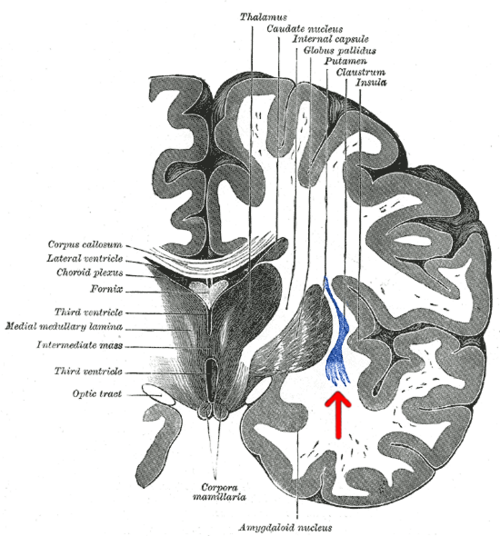
Elizabeth’s scan shows a lesion in precisely that area of the brain (marked in blue with red arrow) which needs to be properly identified.  See also page three of the PDF paper.

This is directly in the meso-limbic pathway and is associated with delusional behaviour in what some people are still calling schizophrenia.   

If you look at page 3 of this paper you will see the brain pictured in coronal, sagittal and horizontal view and the arrows triangulate to where the image/lesion appears in the right hemisphere of her brain on the scan at position 7/24 of the coronal image from the MRI.   

This urgently needs looking at by a neurologist and reference needs to be made to this paper.

Whilst commencing to write this blog Elizabeth has just called. She said yesterday that she spent six hours in seclusion whilst being rapidly tranquilised on Xmas Day.

Despite this, Elizabeth did not sound too bad during her supervised phone call. She spoke of escape. By this she clearly said that she escapes in her mind ie dissociation - this is a sign of PTSD for which Elizabeth has never had any treatment for under NHS. Also she has never had underlying pathological tests until I have had to point out the results of the private scan and observations by independent specialists and experts.

With an appointment on the 3 January with a Neurologist that had previously been flatly refused I really do hope that once and for all her whole treatment will be reviewed based upon the findings which clearly indicate the above.

It has been a nightmare to even try to get certain doctors to acknowledge let alone look into something that has been clearly stated in the files going back to 2009. This could all indicate why the treatment has not worked for so many years.

I am very unhappy at the current punishment of having the phone taken away for a trial period. This has already been tried before. I see this as bullying aimed directly at me because I am the one being blamed for the ‘episodes’ that look like fits never seen before even though many of these take place when I am not around. The necessity the MDT believes to be right is completely wrong and has not achieved anything before at Ash Villa except mistrust and upset and nothing is being done in line with the law and correct procedures and now these same restrictions incorporating Xmas is yet again being “tried”.

I hope to put an end to this bullying once and for all as that is how we see it. I am not going to sit back and do nothing whilst this punishment continues for years and years on end as I believe the whole environment of a noisy acute ward to be completely wrong and the whole approach of punishment also.

This is punishment not care. Punishment to stop my daughter from going out to the shop in the hospital grounds, punishment from stopping her listening to her music on her phone by keeping it locked away. What is this achieving?  NOTHING but resentment an mistrust and this has been ongoing for one month now with no end in sight.  

“Treat people as individuals and uphold their dignity and to do this you must treat people with kindness, respect and compassion and respect and uphold people’s human rights, challenge poor practice and discriminatory attitudes and behaviour relating to their care.

“Act with honesty and integrity at all times, treating people fairly without discrimination, bullying or harassment.  Keep to the laws of the country in which you are practising. Never allow someone’s complaint to affect the care that is provided to them.”